
Saturday, March 24, 2012
springy
Great week - kalimoxto last night, basqueing in the warm weather with a Spaniard, Greek, Dave and Ann.
Started reading Gödel, Escher, Bach again; tried to talk about it... which didn't go that well. Going to have to focus on forging through its difficult concepts. Computational theory of mind: scares a lot of people.
memories like hyperlinks; in the age post-forgetting;

Wednesday, March 21, 2012
Processing
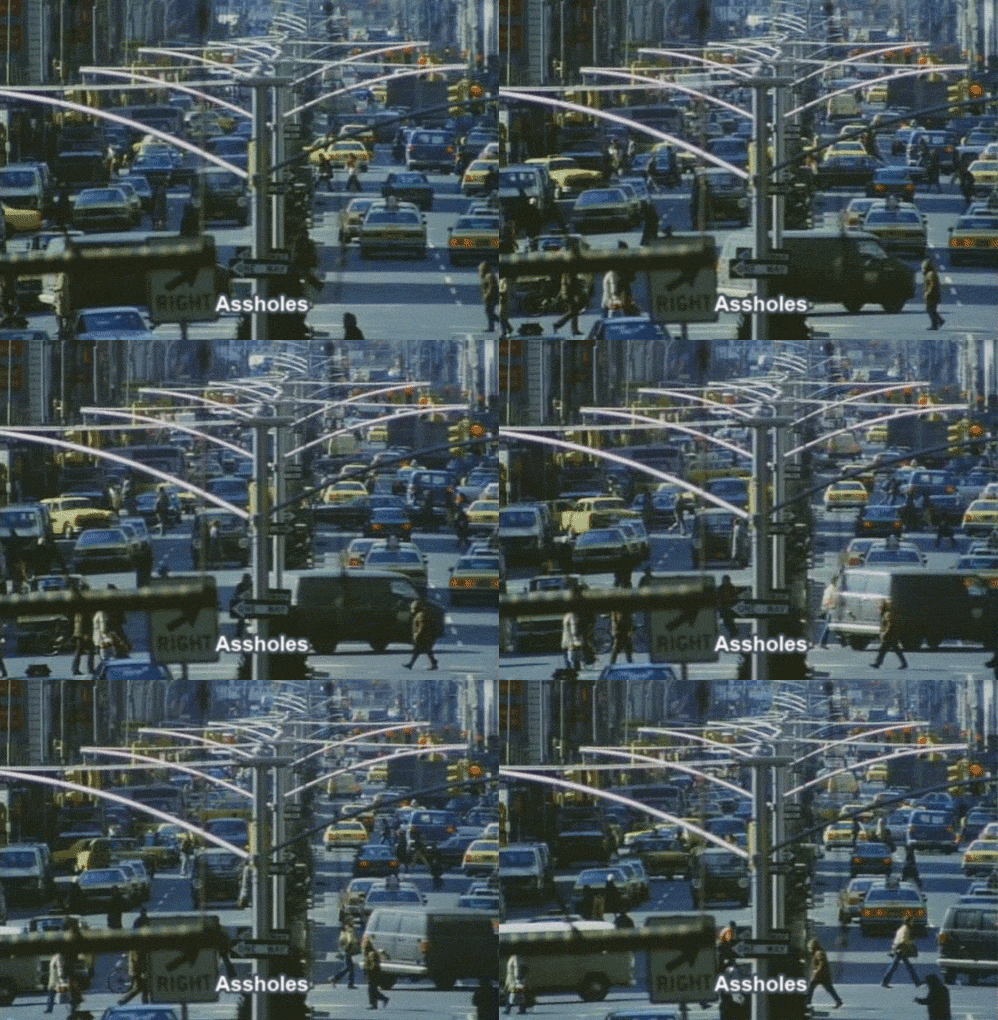
To correct that problem I've started reading Snowcrash again. The author, Neal Stephenson*, is smart - but it must have been hard for him to envisage the growth of big data and mobile. I think those are the two most transitive technologies at the moment (or at least my moment). We spend more and more time on our devices, and that time, that money, that human interaction is heavily quantified and repackaged at profit.
Here - have my hypercard.
* - Stephenson is apparently being paid by Jeff Bezos to develop a manned sub-orbital launch system. That's the coolest job ever.
Wednesday, January 25, 2012
Diamond Age
My strategic marketing class began this past Monday with a discussion of Vincent Negroponte's plan to deliver laptops to every child on the planet. It immediately is striking as a bold enterprise, and one with great promise. Neal Stephenson's excellent book, A Young Lady's Illustrated Primer, raises a good question- ie whether providing raw resources through digital mediums can act as a surrogate teacher.
I'm more concerned with whether or not a non-profit or a for-profit company is better equipped to meet this global need. Negroponte was able to deliver a groundbreaking prototype - which you can buy through a "get one, give one" system similar to Tom's shoes offerings - mainly because the legitimacy of a non-profit allowed the company to draw upon open-source design. Are non-profits able to drive paradigm change faster than their capitalist competitors?
Friday, January 20, 2012
![giveweed.com 2012 1 19 12 30 48 [Hip Hop] Shwayze feat. Adele I Wont Go](https://lh3.googleusercontent.com/blogger_img_proxy/AEn0k_uoLRAwIvLW418pGNizybi0eiJtqdsFIoh9mfWpheGymvfQFxDgWekd32K178-h_LnW3lzbzhbGQm4eVUweS5_ZBnTvWteQJnZ19jA-ZAlbIrMqk65MZY_KZg0G8RNEMlTVXuPROjBmJ4nnrEL5JzSZxJf_tR8M_p7abbUL5TQ=s0-d)
Welcome to the 1%

from Espo's site - first & fifteenth
Stop complaining - you're probably part of the global 1% - individuals earning more than $34,000 annually (according to World Bank data) are wealthier than 99% of humanity.
Stop feeling bad because you can't take the vacation you want, can't afford the beemer parked in your neighbor's driveway...
Start feeling bad because you're a tremendously empowered person, and you're not acting like it.
Thursday, January 19, 2012
Our Very Rich Hours

Jonah Lehrer - How We Decide
Is common sense emotional? I once overheard that the two greatest motivations are sloth and fear. SOPA/PIPA proponents employ fear:
Mr. Dodd said Internet companies might well change Washington, but not necessarily for the better with their ability to spread their message globally without regulation or fact-checking.
"It's a new day," he added. "Brace yourselves."
(from nyt)
Were American consumers (we who depend upon free information to sustain our mindspace), motivated by sloth when they wrote their congresspeople? Or were they motivated by a fear of Orwellian creep? Ann makes a good point here - imagine these ignorant old legislators trying to do research without wiki, or trying to poll public opinion, or broadcast an effective campaign message without truly free information.
Most likely they don't know how to do any to this anyway, as all of this work is offloaded onto twenty-something pages in the belly of Washington DC.
Sunday, January 15, 2012
mental notes - 1/15

algal bloom
Everyone is joking about the end of the world; conversations about dreams of ill-omen. I'm less inclined to believe Aztec powers of prognostication.
I've been focusing on choice, making choices, and predicting the flows of the system you've constructed with your choices. How We Decide - Thinking in Systems - http://info.cern.ch/ - all required reading.
I don't know why we think we could possibly predict something as important, and unprecedented as the End. Maybe we subconsciously realize this, and choose then to give the Aztecs the benefit of the our doubt.
Subscribe to:
Posts (Atom)